The difference between industrial water treatment plants and semi-industrial water treatment plants
Water treatment is a crucial step in many industrial, agricultural, and service processes. Water treatment plants with varying capacities and configurations are designed and manufactured to meet diverse needs.
Reverse osmosis (RO) plants are generally divided into two categories: industrial and semi-industrial plants , each designed for specific water consumption volumes . This article examines in detail the differences, components, performance, construction, operating principles, costs, and applications of these two plant types to help you make an informed decision based on your requirements.
Introduction to the reverse osmosis (RO) water purification system
Industrial and semi-industrial plants typically utilize reverse osmosis . In this technology, water is forced through a semipermeable membrane under pressure, removing impurities, salts, heavy metals, and organic matter. However, the main differences between these two plant types lie in their size, the type of equipment used, and the level of process control.
Industrial reverse osmosis system
ID
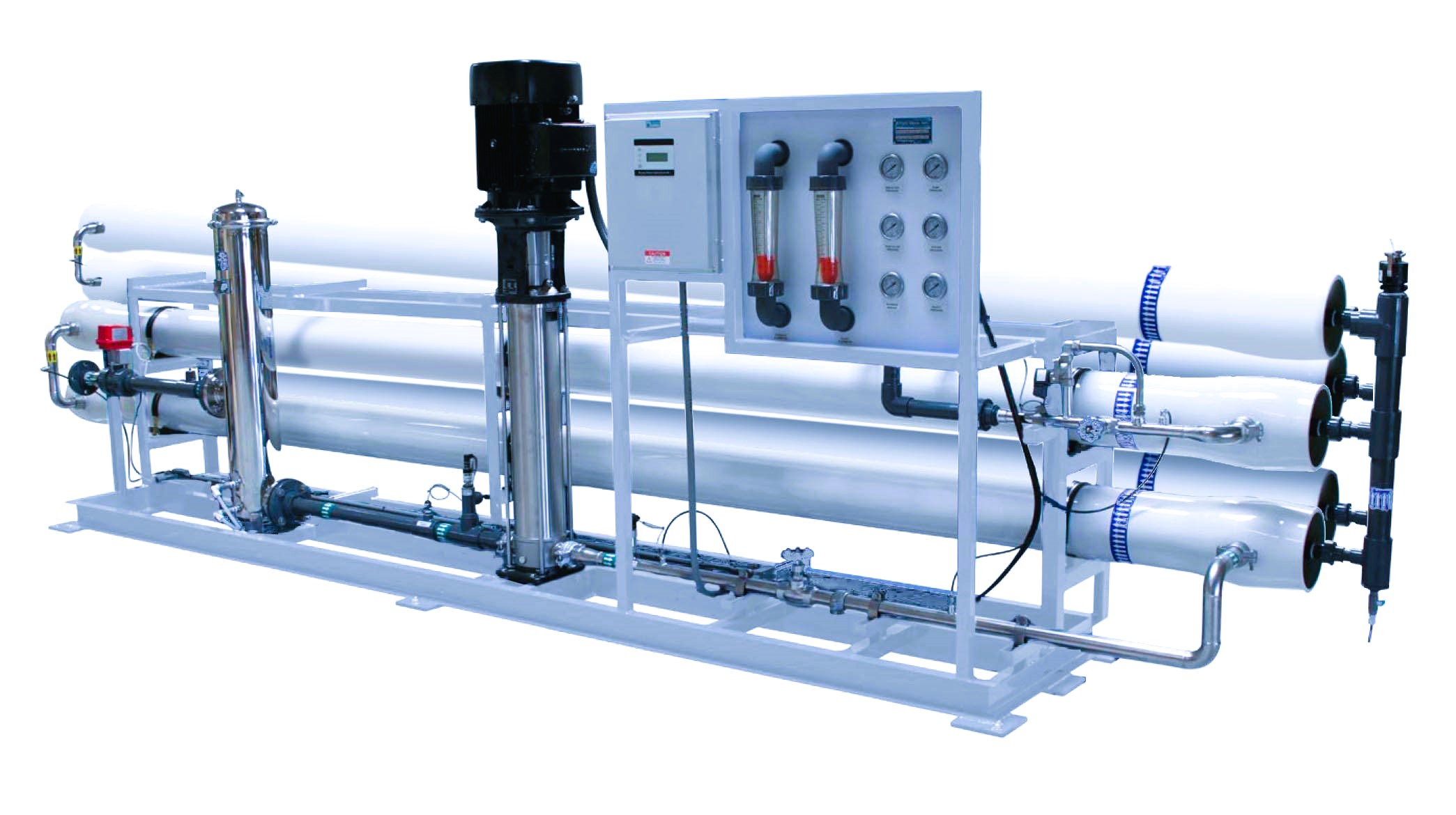
These systems are designed for continuous, large-scale operation and can continuously purify large volumes of water. They are
widely used in various industries, including pharmaceuticals, petrochemicals, steel, power generation, food processing, and manufacturing.
Main components
- Sand filter : Removal of suspended solids and large suspended particles.
- Activated carbon filter : absorbs chlorine, organic substances and volatile organic compounds.
- Cartridge filter : Can remove particles smaller than 5 micrometers.
- High-pressure pump : provides the necessary pressure to force water through the membrane.
- 8 “ Synthetic Membrane : Separation of dissolved salts and ions”
- Stainless steel construction : corrosion-resistant
- PLC or HMI control system : Automatically regulates pressure, flow rate and quality of the outgoing water.
- Chemical dosing pumps : are used to control pH levels and to prevent sedimentation or microbial contamination.
Skills and performance
- Production capacity: from 5 cubic meters to several thousand cubic meters per day.
- Operating pressure of the diaphragm: from 15 to 40 bar, depending on the diaphragm type.
- Water recovery rate: approx. 50% to 75 %
To use
- Stable performance with high productivity
- Longer device lifespan
- The quality of the wastewater is stable and controllable.
- Possibility of using remote monitoring systems
Semi-industrial reverse osmosis system
ID
These systems are designed for locations where moderate amounts of purified water are needed, such as workshops, greenhouses, restaurants, hospitals, laboratories, cafes, or small office buildings.
Main components
- Fiber filter (FF): removes large suspended particles
- Activated carbon filter : absorbs chlorine and organic substances.
- Small pressure booster pump : generates pressure on the diaphragm.
- 2.5- or 4- inch membranes : for cleaning small quantities of water.
- Frame made of non-ferrous metal or light steel
- Simple or semi-automatic control
- Pure water storage
Skills and performance
- Production capacity: from 500 to 5000 liters per day ( from 0.5 to 5 cubic meters per day)
- Operating pressure : approx. 10 to 15 bar
- Water recycling rate: approx. 40% to 60 %
To use
- Small size, easy installation
- Reduction of energy consumption
- Reduced maintenance costs
- Lower purchase price
Detailed comparison of industrial and semi-industrial plants.
| Special feature | Semi-industrial equipment | industrial plants |
| Production capacity | Maximum 5 cubic meters per day | From 5 to several thousand cubic meters per day. |
| membrane | From 2.5 to 4 inches | 8 inch |
| High-pressure pump | Small (up to 15 times) | More (up to 40 times) |
| pre-filter type | In short | Multi-stage (sand, carbon, micron) |
| Structural and connecting materials | Non-ferrous iron or structural steel | Stainless steel 304 or 316 |
| Control type | Manual or semi-automatic | Fully automatic, via PLC and HMI |
| Peripheral devices | limited | Equipped with a jet pump, a sensor and a flow meter. |
| Inquiry | Studio, greenhouse, restaurant, laboratory | Factories, power plants, pharmaceutical and chemical industries |
| Acquisition and maintenance costs | Reduced | higher |
| Potential for improved skills | limited | Very high (standard) |
Differences in wastewater quality
Both systems can produce highly purified water, but industrial systems offer greater stability in water quality.
Due to the precise control of pressure, temperature, electrical conductivity (EC), and pH, industrial systems exhibit less fluctuation in water quality. Semi-industrial systems
are better suited for applications with less stringent water quality requirements (e.g., washing, greenhouse irrigation, or drinking water treatment).
Differences in cost and service
- Acquisition costs : Industrial plants are more expensive due to the use of more powerful pumps and industrial membranes.
- Maintenance costs : Semi-industrial systems require less maintenance and are easy to service .
- Lifespan of the equipment : In industrial plants, the equipment is more durable and easier to maintain, while in semi-industrial plants, the parts are usually replaceable.
This is the best option for you.
The following factors should be considered when choosing between these two devices:
- Daily consumption of clean water
- Quality of the incoming raw water (total dissolved solids content , hardness, microbial contamination )
- End use (drinking water, process water, irrigation water, laboratory water)
- Budget and available installation space
- An automatic control system or a simpler system is required.
Application in various industries
| Industry/Group Type | Suggested system type |
| Greenhouses and micro-irrigation | Semi-industrial |
| Restaurants, cafes and hotels | Semi-industrial |
| small production workshop | Semi-industrial or small-scale industry |
| Food, pharmaceutical and beverage industry | industry |
| Power plants and the oil and gas industry | industry |
| Steel, mining and petrochemical production facilities | industry |
Diploma
In short: Semi-industrial water treatment systems are suitable for medium-sized businesses with limited space and budget, while industrial water treatment systems are used for continuous and intensive water purification that requires careful monitoring of water quality. Both systems utilize reverse osmosis technology but differ significantly in performance, design, components , and durability.
If you are looking for a system that continuously and precisely supplies a factory or production facility
with clean water, an industrial system is the ideal choice. For supplying a small or semi-professional team with high-quality water, however, a semi-industrial system offers optimal efficiency at a lower cost.