Small-scale industrial water treatment | Features, components and applications
He represents
In smaller industrial plants, greenhouses, production facilities, and service centers, a reliable supply of high-quality water is essential, but installing large and expensive water treatment plants is not economical. In such cases, small-scale industrial water treatment plants
are the ideal solution , as they guarantee high-quality water at significantly lower acquisition, installation, and operating costs.
These systems use reverse osmosis (RO) technology or a combination of physical and chemical filtration to remove dissolved salts, suspended solids, chlorine, organic substances and microorganisms from the water.
What is meant by small-scale industrial water treatment?
Small-scale industrial water treatment plants are scaled-down versions of larger industrial plants and are designed for treating smaller quantities of water ( approximately 0.5 to 10 cubic meters per day) . These plants are typically built as integrated units , where all treatment steps (pretreatment, filtration, reverse osmosis, and disinfection) are carried out in a single, compact unit.
Small water treatment plants are typically used in areas with moderate water consumption, where water quality is of utmost importance.
The main components of a small industrial water treatment system
-
Sand filters are used to remove dirt, sand, rust from pipes and suspended particles larger than 20–50 micrometers.
-
Activated carbon filters are able
to remove free chlorine, color, odor and dissolved organic substances from the water. -
Fiber filters (polypropylene filters) are used to remove small suspended particles (1 to 5 micrometers) before they reach the membrane.
-
The high-pressure pump provides
the necessary pressure for the reverse osmosis system. -
The reverse osmosis membrane (RO membrane) is
the most important component of the system, as it is able to separate dissolved salts in the water such as salts, nitrates, sulfates and heavy metals. -
Storage tanks and injection devices for chemical reagents used for pH adjustment, final sterilization or sediment prevention. -
Electrical control cabinets and intelligent control units for automated process control, pressure regulation and membrane cleaning.
The operating principle of a small industrial water treatment plant.
-
Pretreatment:
The raw water first passes through a sand filter and a carbon filter to remove suspended solids and chlorine. -
Fine filtration:
In the next step, the finest particles are separated using a fiber filter to avoid damaging the membrane. -
Reverse osmosis (RO):
A high-pressure pump forces water through a semipermeable membrane.
Pure water can pass through the membrane, but salts and dissolved substances are retained. -
Collection and storage:
The purified water is stored in a final tank and can be disinfected with chlorine or ultraviolet light if necessary.
Application in small-scale industrial water treatment plants
-
Production and service facilities
-
greenhouses and agricultural units
-
Restaurants, cafes and hotels
-
Laboratories and clinics
-
Industrial cleaning systems and steam cleaning
-
Low-performance boilers and steam boilers
-
Introduction to packaging machines or small production lines.
Advantages of using small-scale industrial water treatment plants
 Compact size: Can be installed even in confined spaces such as utility rooms or warehouses . Cost-effective: Lower acquisition and maintenance costs compared to large industrial plants. Quick and easy installation: Most products are supplied as complete units with pre-installed connections . Excellent water quality: Reduces total dissolved solids (TDS) to below 30 ppm. Low energy consumption: Optimizes energy and chemical usage. Scalable: Treatment capacity can be increased by adding membranes or filters.
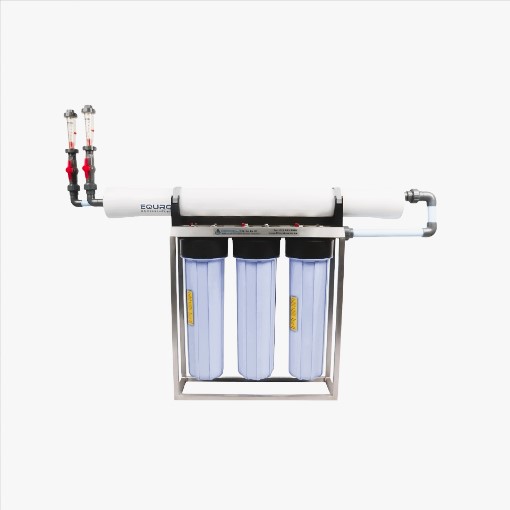
General opportunity
| Filtration capacity | Estimated export flow | Frequently used |
|---|---|---|
| 250 liters per hour | Cafes and restaurants | drinking water |
| 500 liters per hour | greenhouse or small workshop | irrigation or production |
| 1000 liters per hour | Hospitals, factories | Industrial water |
| 2000 liters per hour | Boiler and industrial cleaning | small production line |
Important factors to consider when selecting a small-scale industrial water treatment system.
-
Check the quality of the spring water (total dissolved solids content, turbidity , chlorine content, hardness) .
-
Please specify the type of water used (drinking water, boiler water, washing water, process water).
-
The design must take into account the operating pressure and the temperature of the incoming water.
-
The availability of installation space and the ease of carrying out regular maintenance work are of utmost importance.
-
Choosing membranes, pumps and filters from reputable manufacturers can extend the lifespan of your system.
Assess the impact of membrane fouling on the performance of a reverse osmosis membrane.
Regular maintenance and care
-
Membrane cleaning (CIP): every 3–6 months.
-
Replace the fiber filter every two to four weeks.
-
Rinse the sand and carbon filters in reverse order: once a week.
-
Export pressure and flow control: daily or weekly.
-
Add descaler and chlorine solution : Follow the manufacturer’s instructions.
The difference between small-scale industrial water treatment plants and semi-industrial plants.
| Special feature | Small-scale industrial water treatment | semi-industrial household appliances |
|---|---|---|
| Filtration capacity | From 500 to 5000 liters per day | From 100 to 300 liters per day |
| work pressure | 6-10 times | Two to four times |
| Body and connection | Fiberglass reinforced with steel or plastic | plastic |
| Filtration accuracy | Accuracy down to 0.0001 micrometers (reverse osmosis) | approximately 1 micrometer |
| Inquiry | Factories, workshops and greenhouses | Home and office |
In conclusion
Small-scale industrial water treatment plants are a sensible choice for providing high-quality water on a small scale.
Thanks to their advanced technology , compact design , and low operating costs, these systems are widely used in light industry, restaurants, greenhouses, and laboratories.
By selecting the appropriate capacity and filters, you can improve water quality to meet international standards and avoid damage to your equipment.