Prices for industrial water treatment plants
Industrial reverse osmosis systems are indispensable in many industries, including food processing, pharmaceuticals, steel production, greenhouse farming, and animal husbandry. These systems utilize reverse osmosis technology
to remove salts, heavy metals, and suspended solids from water, producing highly purified drinking water.
However, the price of industrial water treatment plants is not fixed and varies depending on the quality of the construction, the components, the type of incoming water, and the degree of automation.
The following section examines in detail all factors that influence the price and performance of the plant.
 1. The importance of professional design for system performance and recovery
The most important factor determining the quality and price of the devices is the specific system design based on the analysis of the water supply .
All reverse osmosis systems must be carefully planned, taking the raw water quality into account. The following criteria must be considered:
-
Total Dissolved Solids (TDS)
-
General stiffness (hardness)
-
Silicon dioxide, iron and manganese
-
pH value and water temperature
It directly influences the choice of membrane type, operating pressure, pump power and recovery coefficient.
If the system design does not meet professional and scientific standards:
-
These membranes clog up quickly.
-
Operating the water pump under excessively high pressure shortens its lifespan.
-
The quality of the wastewater is unstable.
On the contrary, precise and professional system design ensures maximum efficiency (high recovery rate) , minimal pressure loss , and low energy consumption .
Therefore, a scientifically sound design is a crucial factor for the quality, efficiency, and final price of the system.
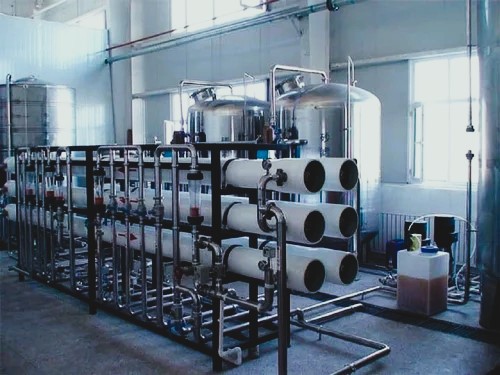
 2. Membrane: the central component of the reverse osmosis system.
The reverse osmosis membrane is the most important and sensitive component
of a reverse osmosis system. Use only original membranes from reputable manufacturers , such as:
-
Movie “Tick” (Dow Chemical)
-
Hydraulic navigation
-
Toray
This improves the accuracy of the desalination process, reduces pressure loss, and extends the lifespan of the system.
Although counterfeit membranes are cheaper, they clog quickly, leading to a significant deterioration in wastewater quality.
Consequently, membrane quality directly impacts system efficiency and operating costs.
 3. Water pumps, control cabinets and equipment
 High-pressure pump
A high-pressure pump generates the necessary pressure to force water through the diaphragm. High-pressure pumps from reputable manufacturers such as CNP, Grundfos, Lowara, and Ebara
are highly efficient and durable. Using inferior pumps can lead to pressure losses and diaphragm damage.
Distribution boxes and control systems
The electrical control cabinet is the heart of the water treatment plant. Semi-automatic systems typically use simple controls, while more advanced models utilize programmable logic controllers (PLCs) and human-machine interfaces (HMIs) with touchscreens for precise control of pressure, temperature, flow rate, and total dissolved solids (TDS). This ensures greater accuracy and efficiency of the system.
Precision instruments and sensors
Precision instruments play a key role in ensuring safe and stable system control.
The following devices are commonly used in industrial plants:
-
Pressure sensor (pressure transducer)
-
Digital flow meter
-
The electrical conductivity sensor (EC sensor) is used to monitor water purity .
-
Sensors for temperature and dissolved solids
-
Automatic control of electromagnetic valves and electromagnetic valve coils
Precise instruments from renowned manufacturers such as Wika, Siemens, Endress+Hauser and Autrol ensure stable operation and prevent pressure spikes or sudden fluctuations.
 4. Quality of building and installation materials
The choice of material has a significant impact on the system’s durability and cost
. High-pressure sections are typically made of 304 or 316 stainless steel , while low-pressure and pre-cleaning lines are made of high-pressure PVC (UPVC or CPVC).
In environments with high salt or chlorine content, stainless steel 316 is recommended for increased corrosion resistance.
 5. Price list for industrial water purifiers (medium quality level, input TDS value 1000 ppm)
| Machine performance | Production throughput (cubic meters/day) | Estimated price (millions of Toman) |
|---|---|---|
| RO-5 | 5 cubic meters per day | 310 million Toman |
| RO-10 | 10 cubic meters per day | 345 million Toman |
| RO-15 | 15 cubic meters per day | 390 million Toman |
| RO-20 | 20 cubic meters per day | 435 million Toman |
| RO-25 | 25 cubic meters per day | 480 million Toman |
The prices quoted are for mid-range equipment, including original American membranes, Italian high-pressure pumps, semi-automatic control cabinets and standard precision instruments, specifically designed for optimal extraction rates and stable operation.
 6. The importance of impact analysis in detailed design
Planning a professional system is impossible without a thorough water analysis.
Before planning, it is essential to analyze parameters such as total dissolved solids (TDS), total hardness, and the levels of iron, manganese, silicon, and free chlorine in order to optimally adapt the system to the actual conditions.
For example:
-
In waters with a total dissolved solids content of less than 1500%, recovery rates of up to 75% can be achieved.
-
In salt water where the total dissolved solids content is greater than 5000, a yield of 45 to 55% is considered appropriate.
Scientific advancements enable significant increases in efficiency, a reduction in energy consumption, and an extension of the membranes’ lifespan.
 7. Important considerations before buying an industrial water purifier
-
Each project requires a specific raw water analysis and planning.
-
Ask the seller about brands of membranes, pumps, control cabinets, precision instruments and building materials .
-
The presence of a CIP (Certified In-Place Membrane Cleaning) system is crucial for the maintenance and regeneration of the membrane.
-
Manufacturers are required to offer customer service and original warranties.
 In conclusion
The cost of an industrial water treatment plant depends on various technical factors, such as professional planning, plant quality, and the brands of components used.
If the system is planned and built taking into account scientific data and a thorough raw water analysis , plant performance, recovery rate, and lifespan can be significantly improved.
Note: The prices shown in the table may vary due to exchange rate fluctuations and the cost of imported equipment. For an accurate cost estimate and a project tailored to your water quality, we recommend consulting a qualified professional.